University of Tennessee - Neyland Stadium
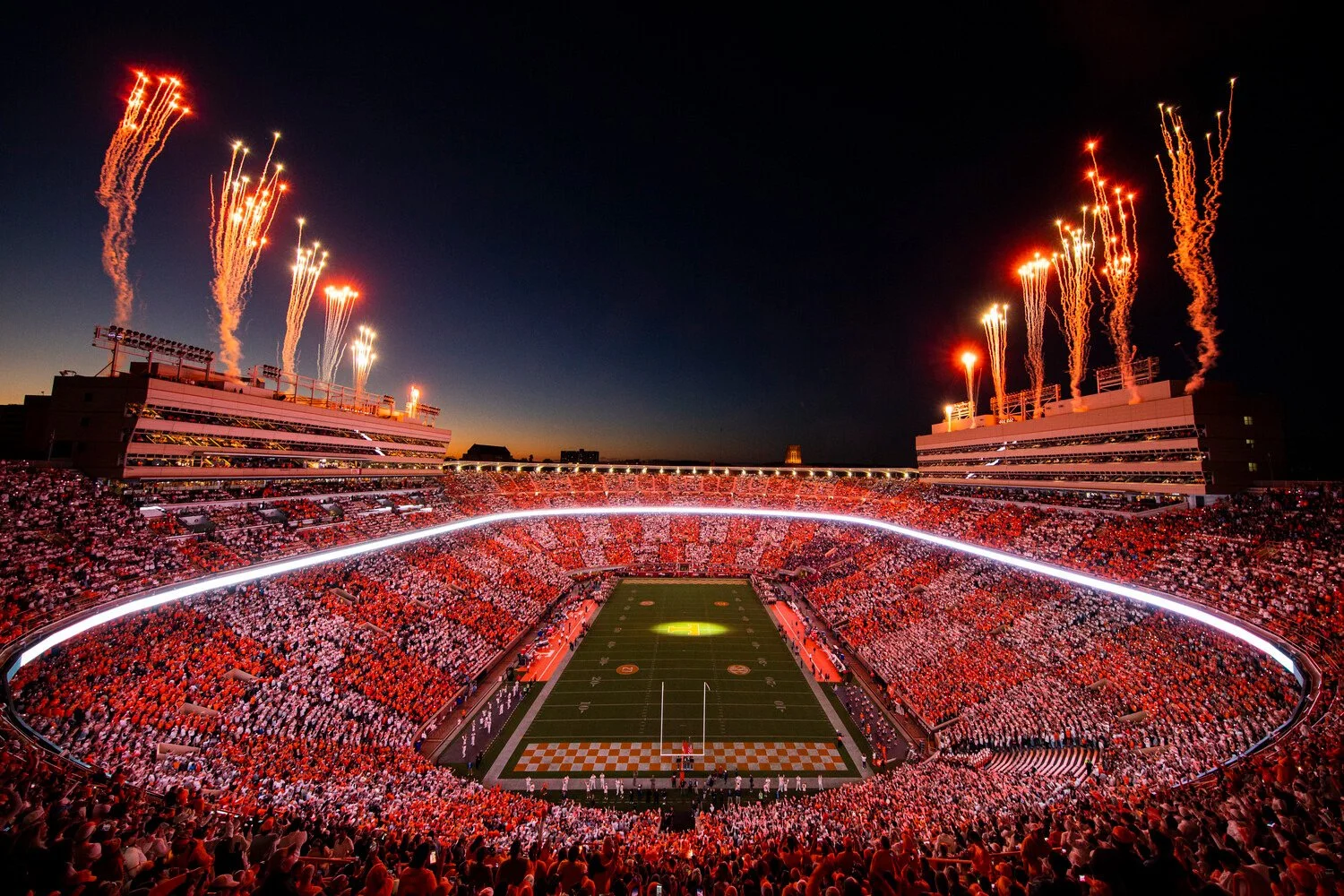
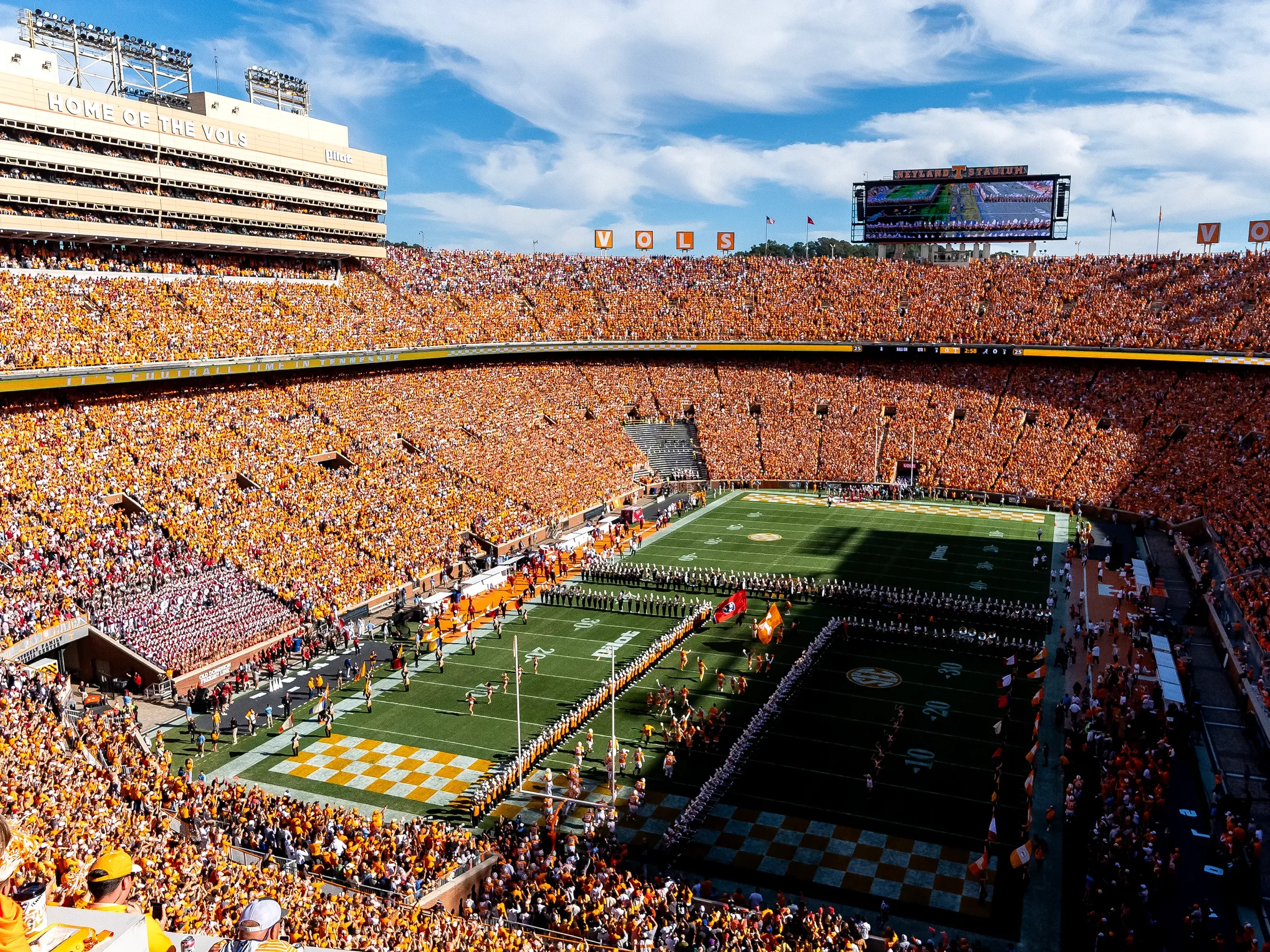
20-20 supported Precision Audio on a major stadium audio-system upgrade at Neyland Stadium in Knoxville, Tennessee, supporting design engineering, EASE acoustic modeling, CAD documentation, rigging documentation, system programming, and large-venue audio integration.
Neyland Stadium is more than a football venue. It is one of the defining game-day environments in college athletics.
From the time fans begin arriving on campus, the experience is built on energy, anticipation, tradition, and scale. The band, crowd, video content, public-address announcements, player introductions, music, and the roar after a big play all contribute to the atmosphere that makes a Tennessee football Saturday feel different.
The sound system is part of that experience.
At Neyland, the goal was not simply to make the PA louder. The goal was to create a stadium audio platform capable of delivering clear, powerful, and controlled sound across a massive open-air environment—supporting everything from critical safety and game operations to music, production, crowd energy, band support, DJ workflows, and the moments that define a Tennessee football Saturday.
The University of Tennessee described the project as an elite, modern sound-system upgrade. The new system includes 15 subwoofers, 11 large full-range loudspeaker systems, 27 compact outdoor loudspeakers, dozens of amplifiers, and more than 500,000 watts of total amplifier power.
Project Summary
Client: University of Tennessee
Venue: Neyland Stadium
Location: Knoxville, Tennessee
Project Type: Collegiate football stadium audio-system upgrade
20-20 Role: Design/engineering support, EASE modeling, CAD and schematic documentation, rigging documentation, and installation support.
Technology That Carries Game Day
Technology does not create tradition. But when it is designed and deployed correctly, it helps carry that tradition into the present.
At Neyland Stadium, the audio system supports more than background music and public-address announcements. It supports the rhythm of the entire game-day experience.
It helps build anticipation before kickoff. It provides clarity when the stadium needs information. It creates impact during entrances, scoring moments, video-board content, timeouts, and fan-engagement sequences. It supports the band, DJ, announcers, production team, and other live-event workflows happening at the same time.
In a stadium environment, attention is always being pulled in different directions. The crowd is watching the field, looking to the video board, listening to the band, reacting to music, responding to announcements, and sharing the moment with the people around them.
A properly designed audio system helps bring those elements together.
The goal at Neyland was to deliver an audio platform that could meet the functional requirements of a major collegiate stadium while also supporting the feeling of being there: the scale, energy, intensity, and shared experience that turns a football game into an event.
System Highlights
Elite modern stadium sound system designed with Danley Sound Labs
Danley J8-94 main arrays, J4-31 and J6-42 fills, Exodus X742 arrays, and BC-218 subwoofers
15 Danley BC-218 subwoofers and more than 500,000 watts of amplifier power
Large-format south videoboard loudspeaker deployment with hundreds of individual drivers operating as a unified source
Distributed coverage for the seating bowl, upper deck, skyboxes, under-balcony areas, field, and game-day support spaces
Danley DNA Dante networked amplification
Allen & Heath dLive production and AHM processing platform
Primary and secondary Dante audio networks with NETGEAR Pro AV switching and fiber connectivity
Shure Axient Digital wireless microphones and Shure PSM 1000 in-ear monitoring
Integrated public-address, music, referee microphone, production, band, DJ, field, and game-day audio workflows
20-20’s Role
Our work focused on helping translate large-venue performance objectives into a coordinated, buildable, install-ready design including documentation and system infrastructure. Stadium audio systems require more than a loudspeaker layout. They require coordination between coverage, long-throw loudspeaker placement, physical mounting, rigging strategy/deployment, networked audio transport, control, equipment-rack locations, operational workflows, and real-world live-event conditions.
20-20’s contribution included:
Design/engineering support
EASE acoustic modeling and coverage analysis
CAD drawing development
Audio-system schematics and signal-flow documentation
Rigging documentation
Loudspeaker layout and placement coordination
Distributed amplifier and equipment-rack documentation
Dante audio-network coordination
NETGEAR Pro AV network coordination
Fiber infrastructure coordination
System-programming support
Large-venue operational workflow support
Why Danley
At Neyland, the loudspeaker system had to do more than cover seats.
It had to carry the energy of game day across a massive open-air stadium. It had to cut through crowd noise, provide clear public-address announcements, deliver impact for music and video content, support referee microphones and in-game audio, and operate reliably through the demands of a full football season.
For Neyland, Danley was the obvious choice—a loudspeaker platform with the scale, control, impact, and outdoor durability required for this environment.
The south videoboard speaker stacks were completely replaced with a large-format Danley deployment. Rather than relying on conventional speaker stacks, the new system uses hundreds of individual drivers inside larger enclosures operating together as a unified source.
The system combines Danley J8-94 mains, J4-31 and J6-42 fill loudspeakers, Exodus X742 arrays, BC-218 subwoofers, OS80 and OS62 under-balcony systems, and GO2-8CX distributed fills.
The new deployment adds 15 Danley BC-218 subwoofers. There were previously no subwoofers. This addition gives Neyland the low-frequency capability required to support modern game-day music, player introductions, video-board content, crowd-pump moments, and the larger-than-life energy expected from one of college football’s most recognizable environments.
Danley DNA Dante amplifiers provide the networked amplification platform, connecting the loudspeaker system to the broader Dante audio, processing, monitoring, and operational infrastructure.
The result is not simply a louder stadium. It is a more intentional, more powerful, and more controlled game-day sound experience.
Networked Audio and Control
Neyland Stadium required more than high-output loudspeakers and amplifiers. The system also needed a network architecture capable of supporting distributed audio, multiple equipment locations, production workflows, wireless microphones, control functions, and game-day operational flexibility.
The platform uses primary and secondary Dante audio networks supported by NETGEAR Pro AV managed switching. Fiber infrastructure connects control, scoreboard, amplifier, and distributed rack locations throughout the venue. This architecture supports long-distance audio transport and coordinated operation across the stadium while allowing major system components to remain distributed where they are needed.
Allen & Heath dLive provides the production-console platform, while Allen & Heath AHM processing supports audio distribution and zone-management functions. The system includes dLive C3500 control, dLive DM32 MixRack, AHM-64 processors, IP8 control, DT168 and DT20 expansion hardware, GPIO control, and distributed networked audio connectivity.
The control-room environment also incorporates Shure Axient Digital wireless microphone receivers, Shure antenna-distribution infrastructure, and Shure PSM 1000 in-ear-monitoring transmitters to support announcer, production, and game-day communications workflows.
Distributed Amplification and Infrastructure
The Danley loudspeaker system is supported by distributed Danley DNA Dante amplification located across multiple stadium equipment and amplifier rooms.
Danley DNA 20K4 Pro Dante amplifiers serve major loudspeaker and subwoofer arrays, while Danley DNA 20K8-C Dante amplifiers support distributed loudspeaker coverage, fills, and other stadium zones.
Distributed amplifier, network, and equipment locations serve the scoreboard system, east and west stadium areas, control-room infrastructure, field and band positions, DJ workflows, and supporting coverage zones.
This distributed architecture allows the system to support the size and complexity of the venue without relying on a single equipment location for every stadium function. It also supports practical cable paths, localized amplification, distributed network connectivity, and greater operational flexibility across the facility.
Rigging and Documentation
Large-scale stadium audio is as much a coordination challenge as it is an acoustical one.
Loudspeakers, subwoofers, amplifier systems, and associated infrastructure must be located where they can achieve the intended coverage while working within the realities of structural steel, scoreboard geometry, sightlines, access requirements, cable pathways, safe installation practices, and future service needs.
20-20 supported the project with CAD documentation, schematic development, loudspeaker layout coordination, and rigging documentation. This work helped communicate the design intent to the installation team and supported coordination between the audio system, physical mounting strategy, and stadium infrastructure.
For an audio system of this scale, accurate documentation is not just a design deliverable. It is a working tool used by the project team to build, connect, verify, and maintain the finished system.
Project Outcome
The Neyland Stadium audio-system upgrade provides the University of Tennessee with a modern, distributed, networked sound platform built for the operational and experiential demands of major collegiate athletics.
The new system is designed to deliver clear public-address announcements, music, referee microphone audio, and in-game content throughout the stadium—from the lower bowl to the upper deck.
The deployment adds substantial low-frequency capability through 15 Danley BC-218 subwoofers, expands large-format full-range coverage, improves coverage beneath the south overhang and along the north side of the east and west skyboxes, and works alongside updated under-balcony loudspeaker systems.
For fans, the result is more than raw output. It is improved clarity, stronger impact, and a more connected game-day sound experience.
For the University of Tennessee, the system positions Neyland Stadium among the most powerful sound-system environments in collegiate sports.
For 20-20, the project demonstrates our ability to support large-scale experiential audio environments where technology is not simply a utility—it is part of how the venue creates anticipation, communicates with the audience, and brings people into the moment.
Completed in partnership with Precision Audio of Raleigh, North Carolina.