
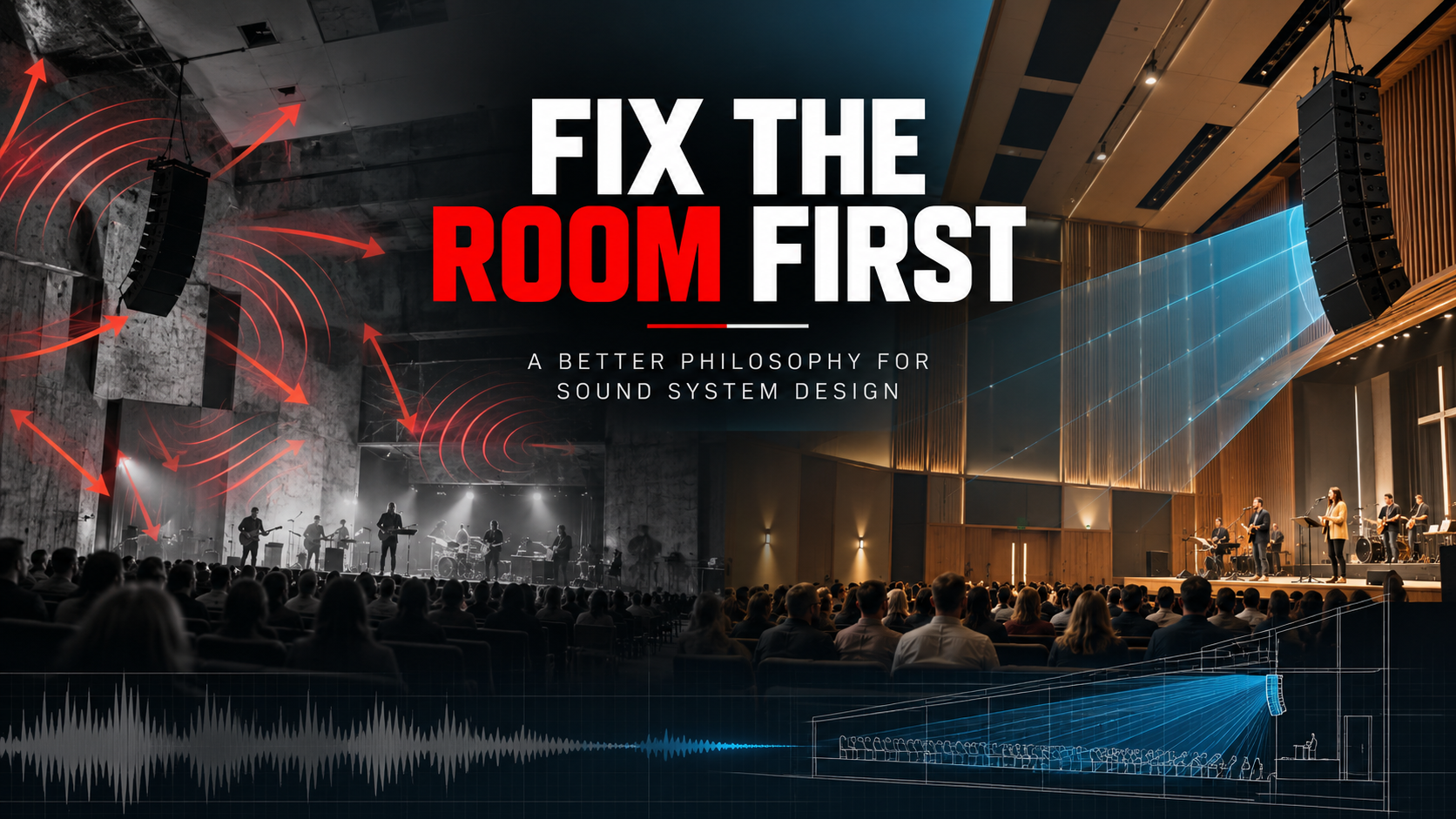
Fix the Room First
It All Begins Here
A Better Philosophy for Sound System Design
There is a tendency in modern audio to believe that almost any problem can be solved with enough processing.
We have incredibly powerful tools. Modern consoles and DSP platforms give us nearly unlimited access to EQ, filters, delay, dynamics, FIR processing, matrices, and more.
But just because we can manipulate a signal doesn't mean we should have to.
At 20-20, our philosophy starts somewhere else:
Fix the room first.
Then put the right loudspeaker, in the right place, pointed in the right direction.
Everything else flows downstream from those decisions.
The Goal: Transparency
A properly designed sound system shouldn't require extensive corrective processing just to sound good.
Processing should be a tool for creative control and intentional change.
It shouldn't be mission-critical damage control.
An engineer should be able to use EQ because they want to shape the character of a vocal—not because they're desperately trying to keep that vocal intelligible in an untreated room.
Compression should control dynamics and create a desired result—not compensate for a system that can't deliver consistent level throughout the audience.
System EQ should refine an already good loudspeaker deployment—not attempt to electronically repair problems created by reflections, poor coverage, or a poor design.
The closer we can get to a naturally good result before processing, the more transparent the entire signal chain can become.
That starts with the room.
1. The Room Comes First
Before we talk about consoles, microphones, amplifiers, DSP, or even loudspeakers, we need to talk about the environment in which all of those things have to operate.
The room is not separate from the sound system.
The room is part of the sound system.
Once acoustic energy leaves a loudspeaker, the electronics have very little control over what happens next.
Sound reflects from walls, ceilings, floors, glass, stage surfaces, balcony faces, and other architectural elements.
Those reflections combine with the direct sound arriving from the loudspeaker.
What the listener ultimately hears is the combination of both.
If the room is well behaved, those interactions can feel natural and pleasant.
If it isn't, they can destroy clarity.
And no amount of expensive equipment changes that fundamental reality.
2. Treat the Problem Where It Exists
One of the most important principles in audio system design is simple:
Solve problems in the domain where they actually exist.
If the problem is acoustic, the best solution is usually acoustic.
If the problem is loudspeaker coverage, fix the loudspeaker coverage.
If the problem is loudspeaker placement, fix the placement.
If the problem is timing or other processing challenges, fix the timing and/or processing.
Only when the physical system is fundamentally correct should processing become the primary tool.
This distinction is important because electronic processing cannot outpace or undo what has already happened physically/acoustically.
An equalizer cannot remove a harsh reflection from the back wall.
A compressor cannot shorten the reverberation time of a room.
You can manipulate the electrical signal all you want.
But eventually that signal becomes acoustic energy.
Physics get the final say.
3. A Good Room Doesn't Mean a Dead Room
"Acoustically treated" does not mean covering every wall with absorptive panels until the room is lifeless.
The objective is not to eliminate the room.
The objective is to control it.
Different rooms have different purposes.
A sanctuary shouldn't necessarily sound like a recording studio.
A performing arts center shouldn't sound like a conference room.
A concert venue shouldn't sound like a classroom.
Good acoustic design considers the intended use of the space and creates an environment that supports it.
That means controlling things like:
Reverberation time
Early reflections
Late reflections
Low-frequency buildup
Flutter echo
Reflective rear walls
Parallel surfaces
Stage acoustics
Background noise
The goal is to create a room where direct sound can reach the listener clearly without being overwhelmed by everything that happens afterward.
4. Then Choose the Right Loudspeaker
Once the room is under control, the next question isn't:
"What's the best speaker?"
It's:
"What's the right speaker for this room?"
There is no universally best loudspeaker.
A fantastic loudspeaker used in the wrong application can produce a terrible result.
A properly selected loudspeaker must account for the geometry and acoustics of the space... the Physics! See a pattern forming here?
That includes:
Horizontal coverage
Vertical coverage
Throw distance
Audience geometry
Mounting height
Available mounting locations
Required SPL
Low-frequency requirements
Architectural constraints
Acoustic characteristics of the room
The goal is not simply to make sound loud enough.
The goal is to put consistent, controlled acoustic energy onto the audience while minimizing unnecessary energy everywhere else.
5. Put Sound Where People Are
This is one of the simplest ideas in sound system design and one of the most important.
Put sound where the people are.
Every decibel of energy we send somewhere else has consequences.
If a loudspeaker's vertical pattern sends significant energy above the audience and onto the back wall, that energy doesn't simply disappear.
It reflects.
If a loudspeaker sprays onto a side wall, that energy comes back.
If we fire energy into a hard ceiling, that energy eventually reaches the listener too—just later.
That means good pattern control is about more than even coverage.
It is also about keeping acoustic energy away from places where we don't want it.
The right loudspeaker allows the designer to cover the audience while minimizing unnecessary interaction with the architecture.
6. Deployment Matters as Much as the Box
Buying the correct loudspeaker is only half of the equation.
It has to be deployed correctly.
Height matters.
Angle matters.
Location matters.
Quantity matters.
Delay matters.
Interaction between loudspeakers matters.
A premium loudspeaker installed in the wrong location can perform worse than a less expensive loudspeaker that was properly selected and deployed.
This is why sound system design should begin before equipment is purchased.
We need to understand the room, model the coverage, understand the acoustic environment, determine appropriate locations, and then select equipment that accomplishes the design.
The loudspeaker should be selected to execute the design. The design shouldn't be created around a loudspeaker somebody already decided they wanted to buy.
7. The Processing Problem
This is where the consequences of poor acoustic and loudspeaker design begin to spread throughout the entire production.
Imagine an untreated, highly reflective room with a poorly deployed PA.
The engineer has to make it work.
So they start correcting.
The vocal gets muddy, so frequencies are cut.
The room gets harsh when the band gets loud, so more frequencies are cut.
The vocal won't sit correctly, so compression gets more aggressive.
Certain microphones want to feed back, so more EQ is applied.
The drums excite the room, so they're manipulated.
The guitars build up, so they're manipulated.
Pretty soon, nearly every input channel is being heavily processed just to make the PA tolerable in the room.
And now we've created another problem.
Those processing decisions don't necessarily stay in the room.
8. Everything Flows Downstream
This is where room acoustics and system design begin affecting things that don't initially appear to have anything to do with the room.
The broadcast mix sounds bad.
The in-ear mixes don't sound natural.
The recording sounds strange.
People start blaming microphones.
Or the console.
Or the IEMs.
Or the broadcast engineer.
But look upstream.
If the FOH engineer is making aggressive channel-level processing decisions to compensate for what the room and PA are doing, those signals may also be feeding other destinations.
Now a vocal that required drastic EQ to survive the room is being sent to someone's in-ear monitors.
Except the in-ear monitors don't have the room problem.
The listener gets the correction without the problem it was intended to correct.
The same thing can happen to a livestream or recording.
The room forced a decision at the beginning of the signal chain, and the consequences traveled downstream.
This is something we encounter constantly.
When an organization tells us:
"Our in-ears just don't sound good."
"Our livestream doesn't sound like the room."
"We can't get vocals to sound natural."
"Everything needs tons of EQ."
Our first question isn't necessarily what console they're using.
We look at the room and the PA.
In our experience, the overwhelming majority of these situations trace back to some combination of poor room acoustics, insufficient acoustic treatment, inappropriate loudspeaker selection, or poor system deployment.
Listen: What Happens When You Get the Room Right
Before we go any further, listen to this.
The video below is not a separately mixed or processed broadcast feed. There is no dedicated livestream engineer, no separate broadcast EQ or compression, and no post-production.
It is simply a direct copy of the house Main L/R mix coming off the console.
In other words, you're hearing essentially the same mix being sent to the PA.
Why does that matter?
Because in a properly treated room, with the right loudspeakers properly designed, deployed, commissioned, and tuned, the FOH engineer doesn't have to destroy the source signals just to overcome the room.
The channel processing can remain relatively natural and transparent—and that pays dividends everywhere those signals go.
FOH → IEMs → Broadcast → Recording
This isn't presented as the perfect livestream mix. A dedicated broadcast mix could absolutely take it further.
That's not the point.
The point is to listen to how good a simple copy of the house mix can already sound when the room and the sound system aren't forcing the engineer into mission-critical damage control.
🎧 Listen for yourself.
9. Stop Asking Processing to Save the System
There is absolutely a place for system processing.
A professionally commissioned system will still use EQ, delay, filtering, limiting, crossover processing, level optimization, and other tools.
But there is an enormous difference between optimization and rescue.
That's the distinction behind Fix the Room First.
Processing should take a fundamentally good system and make it better.
It should not be the thing holding a fundamentally bad system together.
When the room is properly treated and the loudspeaker system is properly designed and deployed, something wonderful happens:
You get to start closer to zero.
The system requires fewer extreme corrections.
Inputs can remain more natural.
Engineers can make decisions based on how they want something to sound instead of how they have to make it sound.
Processing becomes creative again.
10. The Signal Chain Actually Starts With the Room
We normally draw a signal chain like this:
Source → Microphone → Console → DSP → Amplifier → Loudspeaker
Electrically, that's correct.
But from a system-design perspective, we should almost think about it backward:
Room → Coverage Requirement → Loudspeaker → Deployment → Processing → Mix
Because the room determines the problem we're trying to solve.
The room determines where the audience is.
The room determines the acoustic environment.
Those things determine the coverage we need.
The coverage determines the appropriate loudspeaker.
The loudspeaker and architecture determine the deployment.
And only then should processing refine the result.
That philosophy changes the entire approach to system design.
Fix the Room First
A transparent system isn't created by finding the perfect EQ curve.
It's created by getting the fundamentals right before the signal ever needs correcting.
Treat the room appropriately.
Choose the right loudspeaker for that room.
Put it in the right place.
Point it in the right direction.
Make multiple loudspeakers work together instead of against each other.
Then commission and tune the system.
When those fundamentals are correct, processing can finally do what it does best:
Refine. Shape. Enhance. Create.
Not repair.
Everything else flows downstream.